Ummed Bhawan
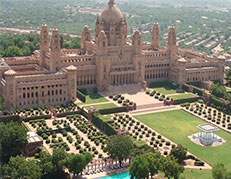
The Umaid Bhawan Palace at Jodhpur, India's last great Palace, was constructed between 1929 and 1944. Constructed in what can loosely be described as the Indo-Art-Deco style, this magnificent edifice with 347 rooms is the world's largest private residence when it opened its doors as a royal residence in 1944. Named after The Late His Highness Maharaja Umaid Singhji, the palace has been the residence of Maharaja Umaid Singhji and his successors. The Central Dome soars 110 feet overhead, and provides spectacular centerpiece - a focal point for all the visitors to the property . The view from the Pillars, especially at sunset, are spectacular. Landscaped gardens adorn the exteriors of the building and the spacious lawns at the rear of the Palace create an ambience which is at once serene, restful and yet spectacularly royal.
Mehrangarh Fort

The impregnable Mehrangarh Fort, which rises above the city, is one of the largest forts in India. As impressive as it is, as a well preserved heritage structure, there's so much more to discover inside. One of the highlights is the museum, which houses an outstanding collection of fine and applied arts from the Mughal period of Indian history. It even has the only professional museum shop in India. Mehrangarh Fort is one of the largest and most magnificent forts in India, standing proudly on a rocky hill overlooking the city of Jodhpur. Built in 1459 by Rao Jodha, the fort showcases impressive Rajput architecture with massive walls, intricately carved palaces, expansive courtyards, and beautifully decorated museums displaying royal artifacts, weapons, paintings, and costumes. Visitors can enjoy panoramic views of the Blue City from the fort's ramparts while exploring its rich history and cultural heritage.
Mandore and Mandore Gardens
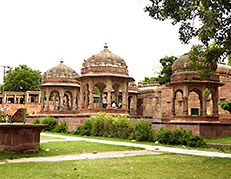
Mandore was the capital of the Marwar region before Jodhpur was founded but now it's in a miserable condition. There's an old fort, as well as an eclectic collection of temples and cenotaphs, and a small museum, in the Mandore Gardens. It could be a really attractive tourist spot if it was properly maintained. The monuments are in ruins and garbage is often scattered around. It's still worth a visit though, for the amazing architecture and history of a bygone era. Mandore Gardens is a historic and beautifully landscaped site located a few kilometers from Jodhpur. Once the capital of the Marwar kingdom, it is known for its elegant cenotaphs (chhatris) dedicated to the former rulers of Jodhpur, ancient temples, lush green gardens, and unique rock terraces. The gardens provide a peaceful atmosphere where visitors can admire the blend of history, architecture, and nature while learning about the region's royal legacy.
Jaswant Thada
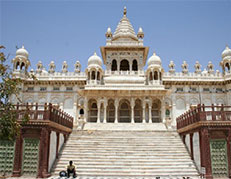
To the left of the Mehrangarh Fort compound is the Jaswant Thada of Jodhpur, Rajasthan. It is a 19th century royal cenotaph built in commemoration of Maharaja Jaswant Singh II, the 33rd Rathore ruler of Jodhpur. The son of Maharaja Jaswant Singh, Maharaja Sardar Singh, in the memory of his father, built the Jaswant Thada. The cenotaph has two more tombs within it. Near to this are the royal crematorium and three other cenotaphs. Jaswant Thada is a stunning white marble memorial built in 1899 by Maharaja Sardar Singh in memory of his father, Maharaja Jaswant Singh II. Often referred to as the "Taj Mahal of Marwar," this architectural masterpiece features intricately carved marble panels that glow beautifully in sunlight. Surrounded by peaceful gardens and a small lake, Jaswant Thada offers breathtaking views of Mehrangarh Fort and serves as a serene tribute to the rulers of Jodhpur.
Rao Jodha Desert Rock Park

Rao Jodha Desert Rock Park was created in 2006 to try and restore the natural ecology of a large, rocky wasteland next to Mehrangarh Fort in Jodhpur. It had suffered years of neglect and was overrun by baavlia (Prosopis juliflora), an invasive, thorny shrub introduced from central America almost a century ago. The challenge was to eradicate the baavlia and create a suitable home for native rock-loving plants that we would bring back from the desert. Rao Jodha Desert Rock Park is an ecological restoration project established near Mehrangarh Fort to preserve the unique desert ecosystem of Rajasthan. Spread across more than 70 hectares, the park is home to native desert plants, shrubs, birds, reptiles, and wildlife that thrive in the arid landscape. Well-marked walking trails allow visitors to explore the natural beauty of the rocky terrain while learning about desert conservation and biodiversity.
Machia bio park
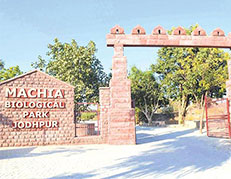
Machia Biological Park will be opened for public in March which will thus put Jodhpur on the eco-tourism map of the country. Spread over 41 hectare, the Rs 32.30-crore biological park will house lions, tigers, jackals, hyenas, desert cats and desert foxes from different zoos across the country, including Jodhpur zoo. Machia Biological Park is a popular wildlife park located near Kaylana Lake in Jodhpur. Designed to promote wildlife conservation and environmental awareness, the park houses a variety of animals, including leopards, lions, deer, foxes, reptiles, and numerous bird species. Visitors can enjoy nature trails, viewpoints, and educational exhibits while experiencing the diverse flora and fauna of the Thar Desert region in a well-maintained natural environment.
Kaylana Lake

Kaylana Lake is located 8 km west of Jodhpur in Rajasthan, India. It is an artificial lake, built by Pratap Singh in 1872. The lake spreads over an area of 84 km2. In ancient times this region had palaces and gardens made by two rulers of Jodhpur - Bhim Singh and Takhat Singh. These were destroyed to make Kaylana Lake. Kaylana Lake is a scenic artificial lake situated on the western outskirts of Jodhpur. Built in 1872 by Pratap Singh, the lake serves as an important source of drinking water for the city and is a popular destination for boating, birdwatching, and photography. Surrounded by rocky hills and natural landscapes, Kaylana Lake offers spectacular sunrise and sunset views, making it an ideal spot for relaxation and enjoying the tranquility of nature.
Osian Sand Dunes
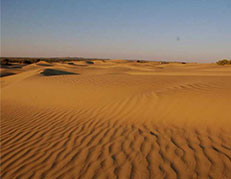
Osian (Osiyan) is an ancient town located in the Jodhpur District of Rajasthan state in western India. It is an oasis in the Thar Desert, and has been known as the "Khajuraho of Rajasthan" for its temples. The town is a panchayat village[1] and the headquarters for Osian tehsil. It lies 69 km (43 mi) by road north of the district headquarters at Jodhpur, on a diversion off the main Jodhpur – Bikaner Highway. The Osian Sand Dunes, located about 65 kilometers from Jodhpur, offer an unforgettable desert experience in the heart of the Thar Desert. Known for their golden sand dunes, camel safaris, jeep rides, and traditional Rajasthani cultural performances, the dunes attract visitors seeking adventure and authentic desert hospitality.
Guda Bishnoi

Guda is scenic beauty marked with Khejri trees and deer. Also in the village is the guda bishnoi manmade lake, around the lake you can see numerous migratory birds like domicile, cranes etc, blackbucks and chinkaras. It is the perfect place to experience the tradition & customs of tribal life. It is a place caught in a delightful time wrap where life still goes on like the days od the past.Guda Village, located about 25–30 kilometers from Jodhpur, is a picturesque rural destination that offers visitors an authentic glimpse into the traditional lifestyle of Rajasthan. Surrounded by agricultural fields, small lakes, and desert landscapes, the village is known for its rich cultural heritage, warm hospitality, and vibrant rural traditions. Visitors can experience village life through camel and jeep safaris, interact with local communities such as the Bishnoi people, observe traditional handicrafts, and witness diverse wildlife, including blackbucks, chinkaras, peacocks, and migratory birds around nearby water bodies.